Pages

Sunday, January 29, 2012

Notes v. photos

While I was in San Francisco last week, I flipped through the small memo notebook I take to every conference I work at. I use the thing to jot down the important stuff that gets said in my meetings with conference chairs. Toward the end of my old notes was this:

Silver van
30923
5:00 am

The note confused me for a moment. Why would I have written down vehicle information like that, including the license plate number? Then it dawned on me that this was the van that picked me up from my hotel in Shanghai early last November to take me to the airport to fly to Korea. The co-organizers of the conference had offered to arrange my transportation, and this was the info they gave me the night before I left. 

Seeing this note brought a warm smile to my face. It recalled the memory so vividly. I remembered Chaoyang calling his driver to arrange it, I remembered scribbling the note, I remembered the anxiety I felt that something would go wrong and I’d miss my flight.

Of all the photos I took on that trip, I don’t think a single one is as evocative as this note was. The thing about photos is that they take you out of the moment. They have to be contemplated, composed, posed, and shot. You’re thinking ahead of time that this will be a keepsake you will use to remember the moment. I find that when I look at my old photos, I remember very little of what it actually felt like to be there. They don’t put me back in my own skin. What was I doing when that photo was taken? Well, I was either clicking the button or I was looking at the lens and trying to smile. There’s not much in that (I don’t think) to attach a memory to.  

A little note like the one I found, though, is all about the moment. I intended it only for immediately practical purposes. It was filling a need I had right then and there. And it also involved some actual doing on my part. So when I stumbled upon it last week, it took me right back to that moment. It did this more effectively than a photo would have, because the note actually had a place in the sequence of events that day. It had relevance for my actions.

A photo is a moment taken out of context. I enjoy looking at them—they can be intriguing—but they give no sense of what came before or next. My stupid little van note’s entire reason for existence was to give a sense of what was coming next. That added context lets me slip back into the thoughts and feelings I had when I was there. 

My note might also be so evocative partly because I never intended to remember it. Last week was the first I had seen it in two and a half months. My photos from that trip, on the other hand, I looked at right after I took. I sorted through them on my computer, shared them with friends and family, gave them captions on Picasa. I was so consumed in them so soon after the fact that when I look at them now I’m not sure if I’m remembering the events themselves or if I’m remembering telling people about them. Maybe I would enjoy my photos more if I left them unviewed for three months after taking them. Remembering is more fun when you’ve given yourself a little time to forget. 


Saturday, January 28, 2012

Inconveniently disposable

I just spent a week working at a conference and trade show put on by my company in San Francisco. The week included lots of paper cups and plastic cutlery. In airports, on airplanes, in hotels, in convention centers—everything is used once and tossed. Most people seem not to notice it. If you go to enough of these things, it just becomes routine.

I was thinking about it when I first arrived in my hotel room, though. I decided I wanted a cup of coffee. All Marriott hotel rooms now have one of those coffee makers that brews one cup at a time using a pre-filled coffee sachet in a disposable plastic tray. Each tray-n-sachet is individually wrapped in plastic. So I tore open a packet, placed it in the machine, and placed a paper cup (also individually wrapped in plastic) under the drip spout. 

Next to the coffee machine are a few more plastic packets labeled “Coffee Valet” in neat curlicue script. Inside each one is a packet of sugar, a packet of artificial sweetener, a packet of non-dairy creamer, and a plastic stirring straw. I only wanted the sugar and the stirring straw, so I left the other contents in the basket next to the machine, hoping they might be picked up by the maid and sent back to the factory to be resealed in a new Coffee Valet, but knowing they’d most likely be tossed.

Since the coffee isn’t that great, I decided I actually needed two packets of sugar. This required tearing open another Coffee Valet and leaving the non-sugar contents sitting sadly in the basket. At this point I was thoroughly shocked at the waste incurred in making a simple cup of coffee. I had a pile of plastic sitting next to me as I sipped from a paper cup that would be added to the pile momentarily. This was my third stay in a Marriott in the past nine months, though, so it wasn’t exactly a new shock. It’s a recurring shock I get every time I travel for work (Although the Coffee Valet is a recent development. They used to have sugar and creamer packets loose in the basket.). 

But I did notice something new this time around. What I noticed is that all this individually wrapped, disposable, single-serving nonsense—besides begin wasteful—isn’t even more convenient. I had to open up six (six!) different plastic or paper packets to make my one cup of joe. I had to sort through what I wanted and didn’t want, and I had to gather up all the spent packets to throw in the trash. Imagine if they had just had a regular coffee machine, regular mugs, and the coffee and accoutrements in jars with scoops. It probably would have taken less time to get my coffee going. There would have been a little cleanup afterward, but how long does that take?

What Marriott is really going for here is not convenience so much as it is the clinical sterility of their facilities. I suppose this is what Americans want. If we had unsealed jars of coffee in our hotel rooms, there would be no telling how the previous guest might have tampered with it. Maybe he rubbed it all over his naked body and then swept it up off the bathroom floor and put it back in the jar. Maybe he ejaculated in it or laced it with strychnine. 

These suspicions may not be totally unfounded, but what does that say about us as a culture and about how we view each other? I remember having coffee at a small guesthouse in Bogor, Indonesia. They had a common area with a hot water thermos, ground coffee in a tub, sugar in a dish, and honest-to-god porcelain mugs. I had plenty of opportunity to do something disgusting like replace the coffee with dehydrated, ground-up deer poop, but I didn’t, and no one seemed to suspect that I would. We all just drank the coffee, and no one got sick. 

I guess a giant chain like Marriott has the money to insulate itself from even the remote chance that someone might get hurt from drinking tampered-with coffee. So why risk it? But there’s still one thing I have to ask about: the Coffee Valet. What the hell is that extra packet for? It makes no sense, Marriott. It makes no fucking sense


Wednesday, January 18, 2012

Where learning takes place

I was fortunate during my first two summers of college to find full-time work at a steel shop in my hometown. It was a big place, full of dangerous machines I had never heard of. I helped out in the weld bay with a bunch of rough but good-natured guys. The hours were long and the workload intense. We made grain silos.

My second summer there actually turned into 7 months, since I was taking a year off from school and saving up money to do some traveling. So I worked in the shop for a total of 10 months, and in those 10 months I learned more than I did in the first two years of college (and maybe all four). I was lucky to work with a few guys who wanted to put me to the test, teach me things, and give me challenging things to do. The job was more like an apprenticeship.

I know I learned more in the shop than I did in college, because I can tell you the things I learned in the shop. I learned how to drive a forklift, how to operate a bridge crane, how to manage steel stock, how to  read engineering drawings and mark hole layouts, how to weld, how to cut, how to punch, how to shear, and how to build things from scratch. What did I learn in Political Science 101 or Anthropology 102? I’m not sure I could name a single thing.

Defenders of higher education would argue that I was learning things in college without realizing it. I was absorbing great ideas in those classrooms, they might say, like an unwitting sponge. This claim is bogus. People know when they’re learning.

It’s not only in retrospect that I see the disparity in my college education and my work education. I saw it at the time, too. The main difference was that the things I learned in the shop had an actual purpose. People will pay money for well-fabricated steel. It adds value to the world. Learning how to make it, then, is probably worth doing.

What value did my time in classes add to the world? Most classes seemed not to have—and didn’t even purport to have—any purpose beyond the circular one of learning the material to pass the final to prove you learned the material. No wonder college students feel uninspired.

Well, learning to work with your hands is all well and good, college apologists might counter, but you also need to be learning larger concepts. Manual labor isn’t enough. Here again, the shop trumped college. There were many concepts to learn, if you were only so receptive. Like I said, I learned what it means to add value and create wealth. I also learned how things work. I learned that everything is part of a system, that everything we have is a product of human ingenuity. I also learned (significantly, considering the prevailing attitudes in universities) that business isn’t bad. Surely these concepts are more important than those taught in Introduction to Psychology.

Ah, but we need cultural enrichment, too. Few jobs can provide that. True, but college doesn’t provide much of it either. Throughout my time in school, I learned more about culture, history, science, and philosophy from the things I chose to read on my own than from what I was assigned in class. Most of what you read in college is either a creative work chosen according to someone else’s tastes or a textbook written by a committee of bored academics. Most students could do a better job of picking their own educational materials. And independent reading was a habit I continued during my time working with steel. I wasn’t missing anything.

University advocates might try to say—as a last resort—my dissatisfaction with school was my own fault. I wasn’t applying myself, or I wasn’t taking the right classes. This wasn’t the case. I really tried.

After my year off, I came back to school (with considerable reluctance) and enrolled in the engineering program. I had learned in the shop how much I enjoyed working with machines, so engineering seemed like a natural fit. What a sad disappointment that was. In my job, I had been designing and building equipment for use around the shop, and I had been processing thousands of pounds of steel a day for multimillion-dollar grain systems. In my Introduction to Design class, I was building a mousetrap car and racing it down the hall with a bunch of 18 year olds. I left the engineering program after one quarter.

The problem with universities is that even when they have students working hands-on, they have them solving contrived problems rather than real ones. How could anyone care about a mousetrap car? Who needs it? The official idea behind projects like mousetrap cars is that students learn principles of design and teamwork in an environment where error will have few consequences.

This thinking is off base. Consequences are essential to learning. Consequences are what drive us. When I started at the shop, I didn’t know how to fabricate steel plates (one of the very basic duties of my new job), but I made sure I learned as quickly as possible, because I knew that failing to do so would have real consequences—possibly for the company and certainly for me personally. 

One of the best learning experiences I had there was when I started independently building equipment and reorganizing parts of the shop to make it more efficient. Talk about learning principles of design! If I didn’t get it right, I would create more problems than I had solved. But I did get it right, and there’s no way I would have bothered doing that work if it hadn’t had the consequence of making job processes smoother and—more to the point—my own job easier.

The benefit of giving young people real problems to work on is twofold: it inspires the capable and weeds out the incapable. With a project as arbitrary as a mousetrap car (or some of the other things I saw higher-level engineering students designing), it’s impossible to tell who’s got what it takes to do the work profitably. In the real world, making something that works well is only part of the process. More important is making something that people want. The test of customer satisfaction quickly reveals who excels and who doesn’t. And those who don’t excel in solving certain problems can begin looking for other ones to solve.

We should worry less about preparing kids for work before letting them do the real thing. Most teenagers could do a useful job reasonably well with only a few hours’ instruction. As they mastered menial tasks, they could be moved up to more responsible positions until they knew the work inside and out. 

The work given to college students is generally infantilizing. It might be unwise to suggest to all kids, “Go out and find a job—any job—rather than going to college.” I was lucky to work in a place where I was treated as an adult and expected to deliver adult results. Many businesses, influenced by the state-mandated structure of young people’s lives, still see an 18 year old as a child. It would be great to see businesses change this thinking—to begin offering interesting apprenticeships and putting young people to real work. If they did it right, they would probably receive a great return on their investment. And there would probably be more learning taking place. 

Tuesday, January 17, 2012

Stuff, desks, fear, success

I have cleared my desk of every last fucking thing I don’t need. I did it about a year ago. And it is awesome.

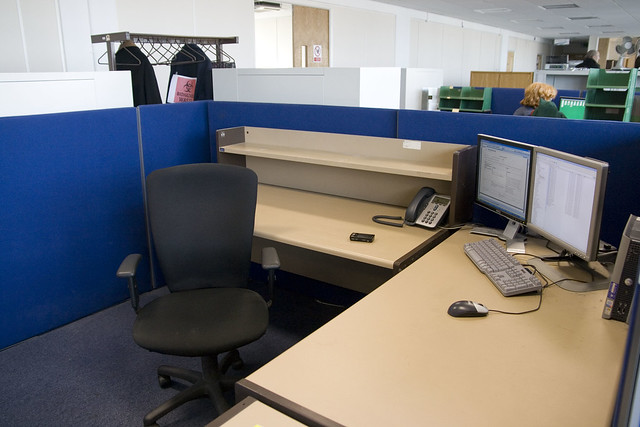
Not mine, but close
When I started at my job, I inherited a desk filled with probably seven years’ worth of office detritus accumulated by previous occupants. The work station had been cleaned, in a manner of speaking, but the “bare essentials” left behind were in fact voluminous and unnecessary. 


I inherited piles of straight pins, push pins, pens, pencils, post-its, paper clips, binder clips, rubber bands, staples, adhesive tapes, and assorted fasteners, joiners, splicers, and sealers (I made up those last four, but the rest is true.). There was also a white-out tape dispenser thing, one or two compartmentalized plastic tray dealies, and a weird, big metal shelf thing with dividers in it where I guess I was supposed to want to put papers or files.

All of these things were left behind in the name of helping me “keep organized.” You never know when you might need to rubber-band 83 different things without any time to walk 30 feet to the supply area! You’ll want to have at least three red pencils handy, because sometimes you’ll get so busy correcting publications that you’ll need to use all three hands at the same time! Be sure to keep a tangled ball of paper clips of varying shapes and sizes in your desk, because we may someday have an emergency situation  in which numerous piles of paper of varying thicknesses must all be clipped together at your desk and your desk only!

One day I finally realized what a pain in the ass it was to see, think about, and smell all that clutter every day (Smelling clutter is hereditary, there was a study). So I got rid of it all. I sort of made it a competition with myself to see how much I could remove, and the answer was a lot. I kept only what I truly used, and of that only very small quantities. Now the insides of my desk contain just a few paper clips, a post-it pad, some files, etc., and the top of my desk has literally nothing but a small pen holder, a water bottle, a tea cup and a drinking glass, my computer, my phone, and a little wireframe organizer that holds folders for the conferences I’m currently working on.

Keeping such a fastidiously spartan workspace has several benefits, the first being that it freaks people out. Most people keep their desktops liberally sprinkled with food scraps from several days ago, unfinished projects from several weeks ago, and sticky notes from several years ago. Seeing a desk so very different from their own unsettles them. This is good. You should always be freaking people out, at least in some small way. If you’re not, you must be doing something wrong.

Another benefit of an empty desk is that it becomes a clean and convenient place to recline (if large enough, which most office desks are). Today I took my shoes off and sat on my desk with my legs all nice and stretched out, and I watched the snow falling outside. It was delightful. I’m thinking sometime I might use the area for a quick nap.

An empty desk also gives you space to work on big projects you’re not supposed to. Yesterday I brought an enormous National Geographic atlas of the world over to my desk and pored over the map of India for a good while. I couldn’t have done that if my desk was as cluttered as most people’s, and I wouldn’t have learned that Assam is in the northeast of the country, near Burma. I had always thought it was in the center, stupid me!

See the incredible rewards of a clear desk? I can only wonder what future successes it will bring.  
  

Saturday, January 14, 2012

Was it worth it?

Earlier today I took a walk through my neighborhood, and I thought about the houses I passed. My apartment building is situated among some very nice homes. They’re old (by West Coast standards) and well-kept. 

I was thinking about whether I wanted one of those houses. As an American, I’m supposed to want a nice house in order to live the American dream. And as a young, employed American, I’m supposed to be seriously thinking about buying one. 

The houses I passed on my walk are truly lovely. They’re tasteful, elegant, diverse in character, and nicely located. They’re places I’m sure I would be pleased to come home to every day. They seem to be filled with classy furniture and fine appliances.

I doubt any of the houses I passed today would sell for less than $300,000, and some of them would go for much more. Throw in all the stuff inside, and you’ve probably got an additional $50,000. Numbers like this are basically unfathomable for me. Even with my pretty decent salary and pretty simple lifestyle, it would take me over 16 years of aggressive penny-pinching to put together that kind of money. And that doesn’t even take into account maintenance costs or interest.

 When I started thinking about the financial side of it, the nice homes seemed much less appealing. I thought about the people inside the homes. 

I’d like to go door to door and ask the homeowners one question: was it worth the price? Most of the people living in those houses probably had to do one of two things to afford them: go into severe debt or slave away at a high-paying job they didn’t like. Many of them probably did both. There might be a guy here or there who managed to become wealthy doing work he loved, and hats off to him. But I’m sure he’s the exception rather than the rule.

So was it worth it? Was everything you put toward the house (or are still putting toward it) money well spent? Was there nothing you would have rather done with that money—or with the time spent making it?

Some would say no to the last question—a house is what they wanted and they’re happy they spent the money on one. But I’ll bet plenty of others—if you really probed into their honest feelings—would admit serious regrets in making such a commitment. Some might wish they’d just saved like crazy and taken time to go traveling. Some might wish they’d have been willing to live in a crappier place so they could have pursued their dream of playing music. Some might wish they’d have just rented a small place and had more time to spend with their kids.

If I were to scrounge together the cash for a down payment on a nice home and move into one in, say, a year, I’m sure it would at first be utterly delightful. No upstairs neighbors, my own washer and dryer, a yard, a place to call my own. Coming home after work would make my day. But it would only be a matter of time before the initial blush wore off and I started thinking over what I had to spend my days doing to afford the place. I would realize that buying a house had done nothing to move me forward in figuring out the life I want. 

Even if my salary were to double—or triple—or quadruple—I still wouldn’t want to buy a house. A five-figure monthly paycheck wouldn’t have me thinking about home ownership. It would have me thinking about all the plane tickets I could buy when I quit in six months. 

I wouldn’t buy a house because it’s not what I truly value. I’m sure plenty of homeowners don’t truly value them, either. They buy them to keep up with the Joneses, or to please a partner, or because they think it’s the best thing to give their kids. And when they realize this, they find themselves ensconced in self-made gilded cages.

Tuesday, January 10, 2012

Greetings and salutations!

Email has forever changed the way we address one another in professional correspondence. It used to be (I’m guessing, and I don’t have the time to research it) that all written correspondence was addressed with a simple “Dear John” or “Dear Mr. Doe.” That’s what they taught us in school. Now there’s an anarchic profusion of email salutations, and I don’t think there’s a single one I actually like. I’ll get to the reasons in a moment, but first here’s a sampling of some of the salutations I get on a daily basis (both from customers and coworkers):

Hi Dan,

Hello Dan,

Hey Dan,

Hi, Dan,

Greetings Dan,

Dan,

Hello Mr. Hauer,

Dear Mr. Hauer,

Dear Mr. Daniel,

Dear Mr. Daniel Hauer,

Dear Dr. Daniel Hauer, (usually comes from Chinese people who assume anyone      working for a scientific society must be a PhD)

Sir,

Dear Sir,

Dear Sir/Madam,

Dear Respected Sir,

And so forth. Some of the funnier ones come from the fact that my company is international and has customers from basically every corner of the globe other than the DPRK. But even within the US—and even within just my own little organization—you still see a good dozen ways to address an email.

The top two in my list are the only ones that don’t really grate on me in some way. I typically address my emails with a “Hi” or a “Hello.” It always feels kind of strange to me to write these verbal greetings, but it at least strikes a balance of being neither too familiar nor too formal.

A “Hey Dan” is too familiar. Or something. Anyway, I feel that only my friends should be allowed to “Hey” me in writing. 

A “Hi, Dan,” makes me think the person writing to me is an English major who’s trying too hard. That extra little comma is technically correct. Grammarians will tell you that any address should be set off by a comma from the person being addressed. (“How are you, Dan?” “Shut up, Dan.” “I don’t know why I bother talking to you, Dan.” etc.) But in an email, a “Hi” is less an address than it is an arbitrary signifier of geniality. And so that little comma is just offensively pedantic.

A “Greetings” isn’t so bad—almost a bit jovial, actually. But it only works with that limited number of people with whom you’re fairly familiar, but with whom you communicate irregularly. If you used “Greetings” with someone you email four or five times a week, it would seem affected and gimmicky, like wearing a bowler hat and horn-rimmed glasses.

A plain old “Dan”—with no salutational sauce on it at all—is too brusque. I feel like I’m about to be ordered to do something.

The use of “Dear” and honorifics doesn’t bother me so much (especially when it comes from foreign folks who try so damn hard, god bless ‘em), but it does make me feel like I’ve been transported back to the 1950s. I’ll respond to a “Dear” with a “Dear,” since I think it’s typically best to reciprocate in these things, and I’ll use a “Dear” when addressing a large group of people I don’t know (“Dear 2012 conference chairs”) or delivering bad news, but otherwise it’s just too formal. Emails aren’t the same as letters, and pretending they are looks silly and outdated. And as far as honorifics go, the only time I really like being called “Mr. Hauer” is when I’m checking into a hotel.

And last of all, the “Dear Sir” emails piss me off because they’re just lazy. I mean, come on man, you must have seen my name on the website in order to get my email address. You should at least take a crack at using my name, even if it ends up being “Dear Mrs. Hauer.”

The point of all this is that you absolutely cannot win when sending work emails. Even though we typically just breeze through the salutation without actually thinking about it, it still affects the tone of the message. You might try to tailor your salutations to the recipient, but from time to time you’re going to flub it and use something that makes you look foolish. And you especially have to worry if you’re sending it to someone like me who overanalyzes everything.


Living in bad design

The building I work in consists of four two-story blocks (each about 100 feet long by 20 feet wide) arranged in a square around a central courtyard. It’s sort of like The Pentagon. But if you made the pentagon a square. 

Someone in HR told me the design of the place had won awards. It’s easy to see why—at first. The building is well-sited on park-like grounds, its interior layout is unlike that of any other building I know, it offers nice views of the area, and it lets in tons of natural light through large windows and skylights. And the geometrically segmented structure of it provides a convenient way to divide up departments (also like The Pentagon).  

It’s only after working in it for a while that I’ve noticed serious design flaws. All of the hallways are built for precisely one person. They’re way too narrow—42.5 inches wide, to be exact (I came in before anyone else this morning and measured.). In America, we generally like to have about two-and-a-half to three feet of personal space. So when two Americans pass in a hall four feet wide, they both have to get really close to the wall and turn slightly sideways. And we sort of squeeze in our arms and avoid eye contact like we’re apologizing for our bodies. It’s awkward, and it happens to all of us multiple times a day.

I have to imagine it’s even worse for the seriously overweight people. Sometimes they have to step into the closest cubicle alcove to let someone pass. Probably doesn’t help their self-consciousness any. Thanks, Mr. Architect, you’ve put the Fat Acceptance movement back 10 years.

There’s one stairway in a high-traffic area that is truly so narrow that only one person at a time can use it (like a ladder). If you spot someone coming down while you need to go up, you have to wait your turn. I hate to imagine what would happen on that staircase in the event of an emergency like an earthquake or a fire. Human stampede!

In another part of the building, the narrow hallway makes a 90-degree right turn followed  immediately by a 90-degree left turn in small area that—with the combination of stairways, bathrooms, conference rooms, and side hallways—has six points of access. You frequently almost run headlong into other people. And this area is right next to the staff lounge. And what is one of the main things people come to the lounge for? Piping hot cups of coffee! Disaster waiting to happen. I’ve yet to hear of someone getting a scalding beverage splashed in their face, but it’s a possibility (Startled coffee drinkers sometimes splash it on the floor and walls, anyway.). 

At what point does bad design become criminal? If I get a coffee or tea burn on my beautiful puss, do I get to sue the architect?

The point is that the building won awards, but it’s actually a bit uncomfortable (and maybe slightly dangerous) to work in. It just shows the difficulty of judging good design. The problems I’ve pointed out probably didn’t occur to the architect, because he was just imagining himself walking through the place. And those problems wouldn’t be apparent when taking a tour of the building, either, which is probably how the award-givers saw it. Only the users, who live in the place, can see what’s really right and wrong. 

People designing software have an easier time meeting users’ needs. They just release a beta version, see what users think, then modify their original code to meet demands. This is a bit harder to do when designing something physical, and especially when designing something that’s a one-time shot—like a a building. I guess architects need to practice empathetic thinking to the point that it’s just second nature.

Why didn’t anyone ask me about this?